
Last updated October 17, 2026
Insulation Permits, Codes & Inspections in CA: What You Need to Know
California’s 2022 Title 24 update quietly raised the minimum attic insulation requirement for Climate Zone 3 (which covers San Jose) from R-30 to R-38 for replacement projects – a change that took effect January 1, 2023. If your contractor quoted R-30 in 2024, they either didn’t update their training or were hoping you wouldn’t notice. This guide walks through exactly when you need a permit, what the CF1R and CF2R documents are, which vapor retarder rules apply in San Jose’s climate zone, and what a failed inspection actually costs to fix. For more guides & resources on Bay Area insulation, see our blog.
Quick Answer
In California, insulation work that qualifies as like-for-like replacement is generally permit-exempt under the California Building Code, but any job involving new insulation in new construction, additions, or changes to the building envelope typically requires a permit and Title 24 Part 6 compliance documentation (CF1R and CF2R). In San Jose, Climate Zone 3, replacement attic insulation must now hit R-38 minimum, and vapor retarder placement rules differ depending on your wall assembly and whether you’re in the City of San Jose or unincorporated Santa Clara County jurisdiction.
Table of Contents
- When You Need a Permit vs. When You Don’t
- Title 24 Part 6: The CF1R and CF2R Explained in Plain Terms
- Vapor Retarder Rules for Climate Zone 3C: What Gets Missed
- City of San Jose vs. Santa Clara County: Checking Local Amendments
- What a Failed Insulation Inspection Looks Like (and Costs)
- Step-by-Step: Getting Insulation Done the Compliant Way in San Jose
- Common Mistakes to Avoid
- Frequently Asked Questions
When You Need a Permit vs. When You Don’t
The question we hear most from San Jose homeowners is simple: do I need a permit to add insulation to my attic? The answer under the California Building Code (CBC) depends on whether your job counts as like-for-like replacement or as new work that alters the building envelope.
Here’s the practical breakdown:
- Permit-exempt (like-for-like replacement): If you’re removing old fiberglass batts and putting new fiberglass batts back in the same cavities, same wall assembly, same R-value or higher, this is considered maintenance. No permit required under CBC Section 105.2, which exempts work that does not change the building’s structural or envelope characteristics. Most blown-in attic top-ups in San Jose fall into this bucket.
- Permit required (envelope change): If you’re converting an unconditioned attic to conditioned space, adding insulation to walls that previously had none, changing from one insulation type to a fundamentally different assembly (like adding spray foam to create an unvented attic), or doing it as part of a larger remodel with a permit already pulled, you need a permit and Title 24 compliance documentation.
- Dollar threshold confusion: Some handymen will tell you there’s a dollar amount under which permits aren’t needed. That’s a misreading of the code. The CBC exemption is about the nature of the work, not the contract price. A $3,000 like-for-like attic top-up may be exempt. A $900 spray foam job that changes your attic from vented to unvented absolutely requires a permit, because it changes the building envelope’s moisture dynamics.
In San Jose specifically, the Building Division has been increasingly strict about spray foam envelope changes. If your contractor tells you a permit isn’t needed for closed-cell spray foam on the underside of your roof deck, check with the city. That change affects how your roof assembly breathes and moves moisture, and inspectors treat it differently than a simple batt swap. A good rule: if the insulation strategy changes the way air or moisture moves through your house, assume you need a permit.
One more trigger worth knowing: any job that requires moving or disturbing more than 32 square feet of drywall to access the insulation cavity will usually pull the whole job into permit territory, because you’re now doing wall assembly work, not just insulation work. We’ve helped homeowners in the Cambrian and Willow Glen neighborhoods sort through this exact question.
Title 24 Part 6: The CF1R and CF2R Explained in Plain Terms
Title 24 Part 6 is California’s building energy efficiency code. Every three years, the California Energy Commission updates it, and the 2022 cycle became enforceable January 1, 2023. For insulation, the two documents you’ll encounter are the CF1R and CF2R.
CF1R (Certificate of Compliance): This is the plan. It’s filled out before work starts, usually by a certified energy consultant, the contractor, or the architect. It specifies exactly what R-value is required for each component of your home – attic, walls, floor – based on your climate zone and the type of project (new construction, addition, alteration). Think of it as the blueprint for what compliance looks like.
CF2R (Certificate of Installation): This is the proof. It’s filled out after installation and signed by the installing contractor, certifying that what was installed matches what the CF1R specified. The CF2R is what the building inspector reviews during the insulation inspection. No CF2R, no passed inspection.
Why should a San Jose homeowner care about these documents? Because they’re your protection. If you ever sell your home, the energy compliance record is part of your property file. If you ever file a complaint about substandard work, the CF2R is the document that shows what the contractor claimed they installed. If a contractor can’t or won’t produce a CF2R for permitted work, that’s a bright red flag.
Here’s the process in the order it happens:
- A certified consultant or contractor determines your climate zone (San Jose is Climate Zone 3, coastal-influenced but with significant heating needs) and calculates required R-values based on the 2022 standards.
- The CF1R is completed and submitted to the building department with the permit application.
- Insulation is installed per the CF1R specifications.
- The installing contractor completes and signs the CF2R, documenting what was actually installed and where.
- The building inspector reviews the CF2R during the insulation inspection and verifies a sample of the work visually.
- Both documents go into your permanent building record with the city.
We tell every San Jose homeowner we work with: ask for copies of both documents before the final inspection. Store them with your deed and other property records. When we handle insulation removal in San Jose and install new material to current code, we hand over both documents without being asked. Ask for a copy to keep with your home records – it’s your right, and it’s the contractor’s obligation.
Vapor Retarder Rules for Climate Zone 3C: What Gets Missed
San Jose sits in Climate Zone 3C, which is classified as a marine-influenced climate with moderate heating needs and low cooling loads. This matters for vapor retarder placement because Zone 3C is a transitional climate where moisture can move in both directions depending on the season. Our Seasonal Insulation Care for San Jose: Year-Round Homeowner’s Guide covers how to manage these shifts.
Under the 2022 California Energy Code, certain wall assemblies in Climate Zone 3C are required to include a Class II vapor retarder on the interior side of the wall. A Class II vapor retarder is a material with a perm rating between 0.1 and 1.0, which is what kraft-faced fiberglass batts provide. Unfaced batts are Class III and don’t meet the requirement in assemblies that call for a Class II retarder. Yet we regularly see unfaced batts installed in San Jose walls where the CF1R specified kraft-faced, simply because the crew grabbed what was on the truck.
Here’s where it gets messy: the vapor retarder requirement is not universal. It applies to specific wall assemblies, particularly framed walls without exterior rigid insulation or with certain cladding types. In a typical San Jose stucco-clad wall with no exterior foam sheathing, a Class II interior vapor retarder is required. But many contractors install unfaced fiberglass and call it done, because it doesn’t look different once the drywall is up and most homeowners never check before the rock goes on. Watch for these issues using our Insulation Warning Signs: A San Jose Homeowner’s Reference Guide.
What happens when an inspector flags the omission after drywall is closed? The inspector records a correction on the inspection report. The remediation options are not great: remove the drywall on the affected wall plane and re-insulate with the correct product, or apply a vapor-retarder paint (which gets you to a Class II rating but requires documentation proving the paint’s perm rating) and resubmit the CF2R showing compliance through an alternative method. The paint route can work if the AHJ (Authority Having Jurisdiction) accepts it, but it requires a resubmission and often a re-inspection.
For spray foam insulation in San Jose, the vapor story flips. Closed-cell spray foam at two inches or more is its own Class II vapor retarder and qualifies without any additional layer. Open-cell spray foam does not function as a vapor retarder and may require an additional vapor control layer depending on the assembly. A contractor who doesn’t know the difference between closed-cell and open-cell vapor behavior is a contractor to avoid.
In our experience working in San Jose attics of 1920s bungalows in the Naglee Park neighborhood and 1980s track homes in Almaden, older homes rarely meet current vapor retarder code. That’s fine – code applies when you alter the assembly, not every time you open a wall. But if your project pulls a permit for an addition or a gut remodel, the new work has to meet 2022 standards, and that includes the vapor retarder details.
City of San Jose vs. Santa Clara County: Checking Local Amendments
California energy code is statewide minimum, but local jurisdictions can adopt amendments that are stricter. The City of San Jose and Santa Clara County both have processes for adopting local code amendments, and they occasionally tighten requirements beyond the state baseline.
For insulation specifically, the practical difference usually shows up in three places:
- Re-inspection thresholds: Some jurisdictions trigger a re-inspection for any insulation correction, even minor ones. San Jose’s Building Division generally requires a re-inspection for any failed item, with a fee.
- Spray foam documentation: San Jose has been more aggressive than the state baseline in requiring third-party test documentation for spray foam jobs, particularly in unvented attic conversions. The city wants to see the manufacturer’s ICC-ES report and evidence the product was installed at the specified thickness and density.
- R-value verification for blown-in: Santa Clara County inspectors often check blown-in insulation depth versus coverage area more carefully than state minimums require. They’ll ask for the installed depth chart from the manufacturer and verify coverage with a depth gauge, not just visually.
The easiest way to check current local amendments for your address:
- Go to the City of San Jose Building Division website or the Santa Clara County Planning and Development site, depending on jurisdiction.
- Search for “local amendments” or “building code amendments.” San Jose publishes a list of adopted amendments to each code cycle.
- Look for anything that references the California Energy Code, Title 24 Part 6, or insulation.
- If nothing shows up in your search, call the building department’s general information line. A five-minute phone call can save you a failed inspection.
There’s also the question of what codes are in effect right now. As of early 2026, San Jose is enforcing the 2022 Title 24 standards adopted with a January 1, 2023 effective date. But the 2025 Title 24 update cycle is already drafted and has an expected January 1, 2026 effective date for applications submitted after that date. If your project pulls a permit in 2026, you may be looking at the 2025 standards, which raise attic insulation minimums slightly in some climate zones. Always ask the building department which code cycle applies to your permit application date, not just which cycle is “current.”
What a Failed Insulation Inspection Looks Like (and Costs)
A failed insulation inspection in San Jose is not a catastrophe. It’s a paperwork and labor matter, not a structural emergency. But it does cost money and time.
Here’s what typically happens: the inspector arrives at the insulation inspection stage, which occurs after the insulation is installed but before drywall is closed (for walls) or before the attic access is sealed (for attics). The inspector checks the CF2R against the CF1R, then visually inspects the installation. Common failure items we see in Santa Clara County:
- Insulation R-value lower than the CF1R specifies (R-30 installed when R-38 was required)
- Missing vapor retarder where the assembly calls for one
- Gaps or compression in batt installation (batts stuffed into cavities smaller than the batt width, crushing the loft and reducing effective R-value)
- Spray foam depth below specified inches
- Missing documentation (no CF2R, no product data sheets, no ICC-ES report for spray foam)
- Incomplete coverage in one side of the attic (one slope insulated, the other not)
The cost to remediate a failed insulation inspection in San Jose usually breaks down like this:
- Re-inspection fee: $150 to $350, depending on the jurisdiction and the trade. San Jose’s current fee schedule for a re-inspection of this type typically falls in that range.
- Correction labor: $200 to $600. It might mean removing a section of drywall to fix a vapor retarder, adding blown-in insulation to reach R-38, or removing and replacing compressed batts.
- Documentation resubmission: Usually no charge, but it adds two to five days of schedule delay.
- Total typical remediation cost: $300 to $800, plus the delay.
The worst-case scenario we’ve seen in San Jose was an unvented attic spray foam job that failed inspection because the foam depth was 2.5 inches on a slope where 4 inches was specified. The homeowner had to pay for an additional foam lift (about $1,200), a re-inspection ($225), and waited three weeks for scheduling. The original contractor had gone out of business, so the homeowner had to pay another contractor out of pocket. That’s the expensive version of a story that could have been caught with a tape measure and a phone call before the first inspection.
When we do spray foam insulation in San Jose, we verify depth with a gauge in front of the homeowner before any inspection is scheduled. It’s not a magic trick. It’s just checking the work before someone else checks it for you.
Step-by-Step: Getting Insulation Done the Compliant Way in San Jose
Here’s the sequence we recommend for any San Jose homeowner planning insulation work, whether it’s a simple attic top-up or a full spray foam conversion. Start with our Attic Insulation Maintenance Checklist for San Jose Homeowners to assess your current condition:
- Determine your jurisdiction. Put your address into the City of San Jose’s property lookup tool. If it shows “unincorporated Santa Clara County,” you’re dealing with the county’s building department, not the city’s. The process is similar but the offices and fee schedules are different.
- Figure out if you need a permit. Use the like-for-like test from the first section of this guide. If you’re not sure, call the building department. They’ll tell you over the phone. It’s a free call and it takes ten minutes.
- Get a written quote that specifies R-value. Not a verbal quote that says “we’ll top it up.” A written line item that says “blown-in fiberglass, R-38 minimum, 14 inches settled depth.” If the contractor won’t put R-value in writing, find another contractor.
- Ask about the CF1R and CF2R upfront. If your job needs a permit, ask who prepares the CF1R and who signs the CF2R. Get it in writing. A contractor who has never heard of a CF2R has never done a permitted insulation job.
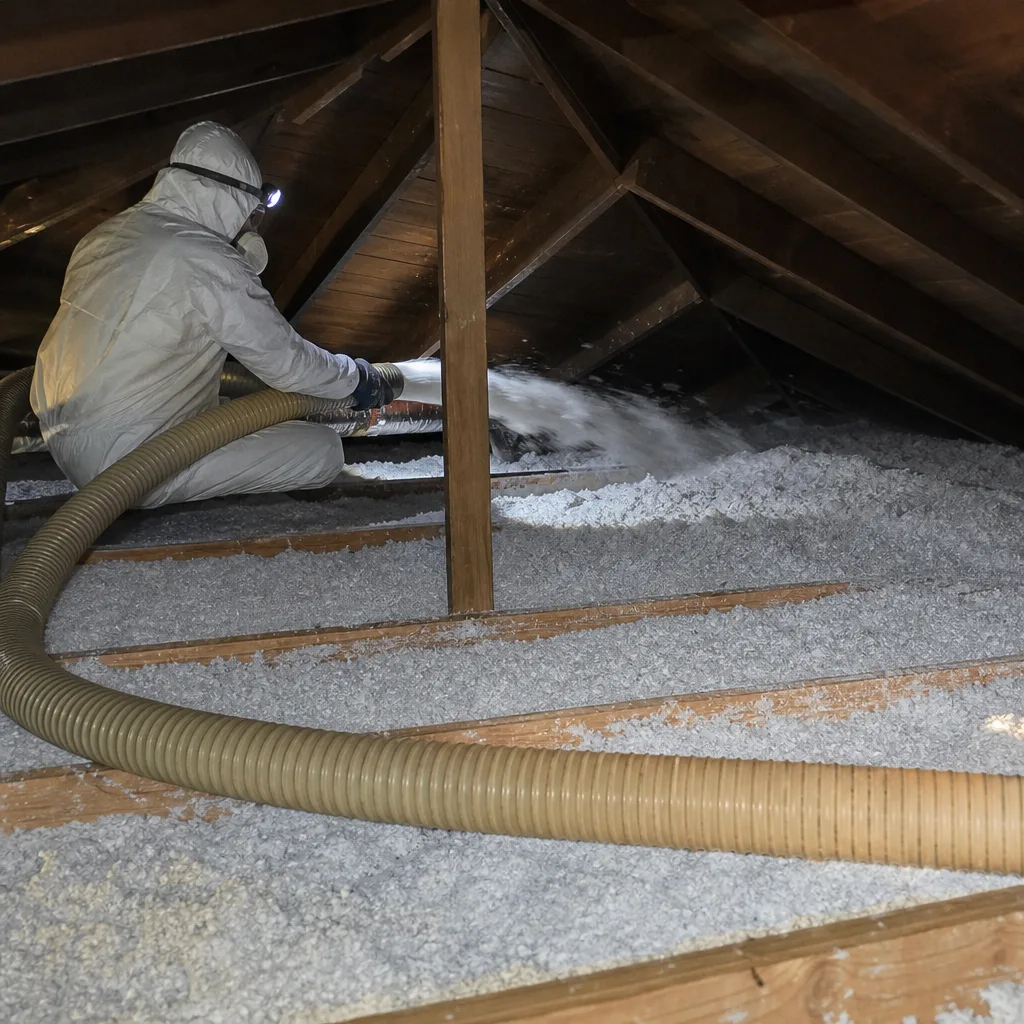
- Verify the installed R-value before inspection. If it’s blown-in, measure the depth yourself with a ruler before the inspector arrives. A chart from the manufacturer will tell you what settled depth equals what R-value. For fiberglass, R-38 is about 14 inches of settled depth. For cellulose, R-38 is about 10.5 inches. If the depth is short, call the contractor before the inspection is scheduled.
- Attend the inspection. You have the right to be there. Ask the inspector what they’re checking and take notes. If anything fails, ask exactly what needs to change and whether a re-inspection is required.
- Keep your documents. CF1R, CF2R, product data sheets, and photos of the installed insulation all go into a folder. This is your compliance record if you ever sell, refinance, or need to prove what was done.
This process applies whether you’re working with us or any other contractor. A good contractor will run this process without being asked. A bad contractor will act annoyed when you ask about any of it.
Common Mistakes to Avoid
- Accepting a quote that doesn’t specify R-value. If the contract says “insulate attic” without a number, you have no idea what you’re paying for and no recourse if it fails inspection. Insist on a written R-value target that matches or exceeds the current code minimum for San Jose.
- Assuming the contractor knows the 2022 code update. The R-30 to R-38 change for Climate Zone 3 took effect January 1, 2023. Contractors who don’t do continuing education or don’t pull permits regularly may still be quoting to the old standard. The code applies to your project based on the permit application date, not the contractor’s memory.
- Treating spray foam as an insulation-only decision. Converting a vented attic to an unvented spray foam attic changes the entire moisture and air strategy of your roof assembly. It’s not just “better insulation.” It’s a different roofing and ventilation system. We see homeowners treat it as an insulation upgrade when it’s really an envelope redesign, and the code treats it that way too.
- Not asking about the vapor retarder. In Climate Zone 3C, the vapor retarder placement can be the difference between a passed inspection and a drywall tear-out. Ask your contractor: “Does this wall assembly need a Class II vapor retarder, and what are you installing?” If they don’t understand the question, get someone else.
- Skipping documentation because the job is small. A $400 attic top-up may not need a permit, but it still needs a written description of what was installed and at what R-value. When you sell the house in five years and the buyer’s inspector asks what’s in the attic, a receipt with “insulation – $400” is not an answer.
- Not checking local amendments. San Jose and Santa Clara County both have the legal ability to adopt stricter standards. The state minimum might not be the local requirement. One phone call to the building department confirms which code cycle and which amendments apply.
When to Call a Professional
If your project requires a permit, involves changing your attic from vented to unvented, or touches a wall assembly where vapor retarder placement matters, call a professional who does permitted insulation work regularly. This is not the job to hand to a generalist handyman with a truck and a free afternoon. The cost of a pro is almost always less than the cost of a failed inspection, a drywall tear-out, or a home sale that stalls because your energy compliance record is incomplete. Laurel Attic Insulation San Jose works through these questions every day. Attic Insulation in San Jose is the largest share of what we do – Insulation Removal in San Jose is the other piece – and we walk every homeowner through the permit, documentation, and inspection process before any material goes in. Laurel Attic Insulation San Jose offers free estimates in San Jose – call (669) 333-7274.
Frequently Asked Questions
No, if it’s like-for-like replacement (removing old insulation and installing new insulation of equivalent or higher R-value in the same assembly), the California Building Code exempts it from permit requirements. Yes, if you’re changing the assembly (like converting a vented attic to unvented spray foam), adding wall insulation to previously uninsulated walls, or doing the work as part of a larger permitted remodel. When in doubt, call the San Jose Building Division – they’ll give you a direct answer over the phone.
For Climate Zone 3, the 2022 Title 24 standard requires R-38 for attic insulation in replacement projects, up from R-30 under the previous code cycle. For new construction, the requirement is R-38 as well. These numbers apply to typical vented attic assemblies; unvented spray foam attics have to meet a U-factor (heat loss rate) target instead of an R-value target, which typically means 4 to 5 inches of closed-cell foam on the roof deck. Call (669) 333-7274 for a free assessment of what your specific house needs.
The CF1R is the Certificate of Compliance – the plan that says what R-value and assembly details your project needs to hit, prepared before work starts. The CF2R is the Certificate of Installation – the proof that what was installed matches the plan, signed by the installing contractor after the work is done. Both are required for any insulation work tied to a permit, and both should be kept with your home records permanently.
Typically $300 to $800 including the re-inspection fee (about $150 to $350 in most San Jose and Santa Clara County jurisdictions) and correction labor (typically $200 to $600, depending on what needs fixing). The bigger cost is schedule delay – a failed inspection can add two to four weeks to a project while corrections are made and re-inspection is scheduled. Getting the R-value and vapor retarder right the first time is the cheapest path.
Yes, generally. San Jose and Santa Clara County inspectors typically require more documentation for spray foam jobs, especially unvented attic conversions. Expect to provide the manufacturer’s ICC-ES evaluation report, verification of installed thickness and density, and sometimes third-party test data. Fiberglass and cellulose jobs are usually simpler: the inspector checks the R-value, coverage, and the CF2R against the CF1R. For spray foam work in San Jose, it’s worth working with a contractor who has done permitted spray foam in your specific jurisdiction.
Nothing. Code applies to the project, not to the existing condition of the house. A home built in 1985 with R-19 attic insulation is not out of compliance unless and until you do work that triggers a permit. At that point, the new work has to meet current code. You are never required to bring your entire existing house up to current standards just because you’re adding insulation to one part of it.
The Bottom Line
California’s insulation code is not a mystery if you know which questions to ask. Ask whether your job needs a permit. Ask what R-value your specific climate zone requires under the current code cycle. Ask who fills out the CF1R and CF2R and whether you’ll get copies. Ask about the vapor retarder for your wall assembly. Ask if your local jurisdiction has amendments beyond the state minimum. If you’re in San Jose and want a contractor who answers those questions with specific numbers and documentation before any work starts, call Laurel Attic Insulation San Jose at (669) 333-7274 for a free estimate. We’ll put the R-value, the permit path, and the inspection plan in writing before a single staple goes into your attic.
Written by Chase Whitaker, Owner at Laurel Attic Insulation San Jose, serving San Jose since 2003.