
CertainTeed Radiant Barrier Installation: The San Jose Owner’s Guide
If your CertainTeed radiant barrier has torn, sagged, or detached from the roof deck, we stock the materials to fix it and install replacements throughout San Jose, typically for $680 to $1,450 depending on attic size and access. Most radiant barrier work is done same day or next day. You’ll usually discover the failure the same way every San Jose homeowner does: you go up to grab holiday decorations in July, it’s 140 degrees in the attic, and the foil is hanging down like old wallpaper.
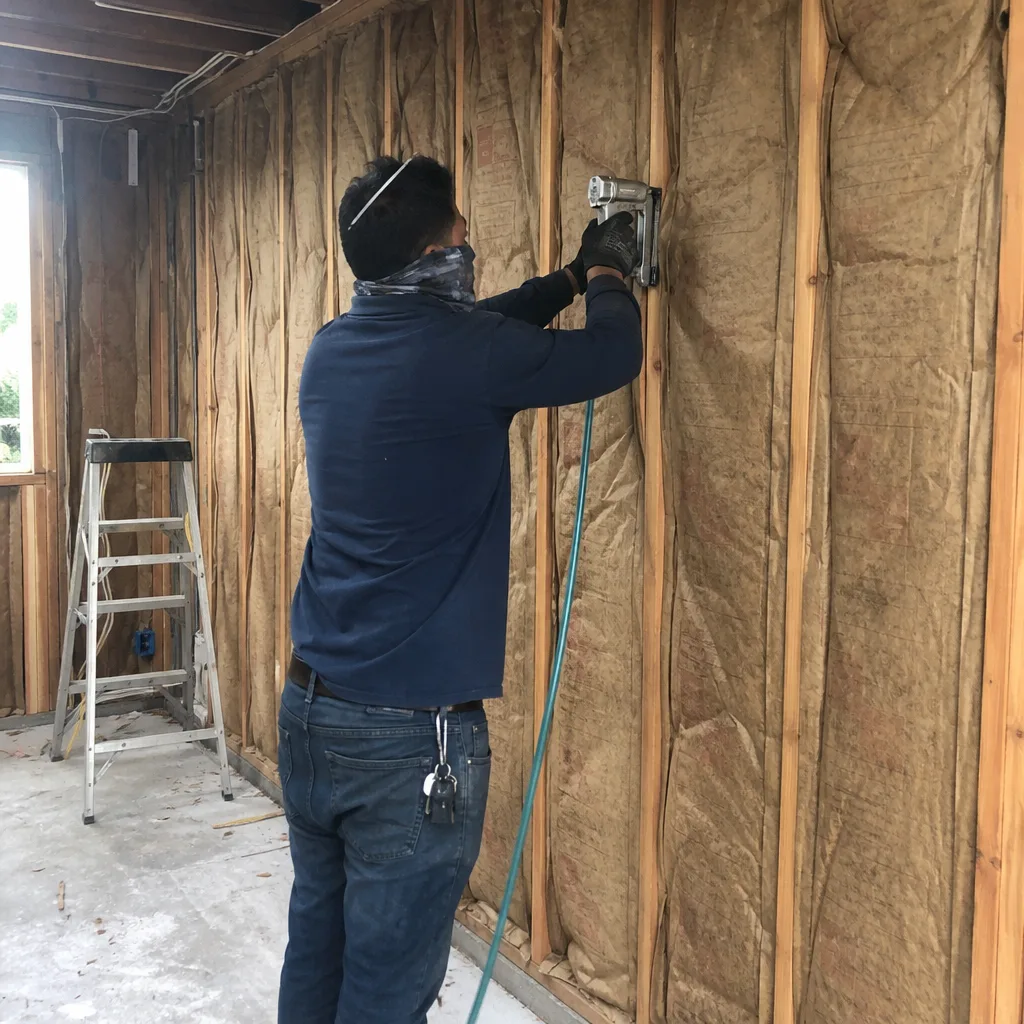
Radiant barrier is a foil-faced material stapled to the underside of your roof rafters. It works by reflecting radiant heat back out through the roof instead of letting it soak into your attic. When it fails, your attic temperature climbs, your AC works harder, and your upstairs rooms never quite cool down. We’re Chase Whitaker’s crew at Laurel Attic Insulation San Jose, and we’ve been replacing failed radiant barriers in San Jose attics for years. Here’s what you need to know before you spend a dollar.
Which CertainTeed Models This Applies To
The two CertainTeed radiant barrier products we see most often in San Jose homes are CertainTeed Enerfoil and the radiant barrier facing integrated into CertainTeed’s insulated roof panels. Enerfoil comes in rolls: the standard residential widths are 48 inches and 60 inches, with perforated versions available for attics that need vapor transmission. The perforated option matters more in San Jose than in, say, Phoenix, because our winter mornings bring condensation and an unperforated foil can trap moisture against the roof deck.
If you’re not sure which product you have, look for the printed brand stamp on the foil edge. Enerfoil carries a repetitive CertainTeed logo pattern. If the foil is laminate-bonded to foam board or OSB, you have the integrated panel product, not the roll form. The two are not interchangeable: the roll form installs over existing rafters with staples, while the panel product replaces or supplements roof decking. If your home was built between 2005 and 2018 in new developments in areas like Evergreen or Almaden Valley, there’s a good chance you have the roll form.
For replacement work, we typically use genuine CertainTeed material when the existing barrier is under warranty or when the homeowner wants exact brand continuity. CertainTeed’s radiant barrier carries a limited warranty, and matching the original product helps keep that intact. However, Reflectix makes a competitive foil-faced barrier we also stock, and for exposed-rafter retrofits it can be a sensible cost alternative. We’ll tell you honestly which one makes sense for your attic layout. We’re an independent San Jose installer, not a CertainTeed dealer, which means we recommend what actually fits your home, not what’s on some corporate fulfillment sheet.
Signs Your CertainTeed Radiant Barrier Installation Is Failing
Radiant barrier doesn’t fail suddenly. It degrades in ways you can spot if you know what to look for before your cooling bills spike. Here’s what we see in San Jose attics, especially in older ranch homes around Willow Glen and Cambrian where roof pitch and attic access make inspection easy to skip:
- Foil sagging or detached from rafters. Staple pull-out is the most common failure mode. Roof decking shifts with humidity cycles, and after enough seasons, the staples lose grip. The foil loses its flat plane, which is what gives it reflective performance.
- Torn or ripped sections near roof penetrations. Plumbing vents, attic fans, and recessed lighting cans create gaps in the foil. If a previous contractor cut around these carelessly, heat pours through the gaps like an open window.
- Dust buildup dulling the reflective surface. Radiant barrier works only if the surface facing downward is shiny and dust-free. In San Jose’s dry summers, blown-in dust accumulates quickly. A dusty foil reflects far less heat than a clean one.
- White oxidation or corrosion spots. If your foil shows chalky white patches, moisture has reached the aluminum layer. This often happens near soffit vents where outside air carries dew into the attic.
- Upstairs rooms 8-12 degrees warmer than downstairs in summer. You can feel this one. If your thermostat says 74 but the upstairs bedrooms feel like 80, the barrier has likely lost effectiveness even if nothing looks wrong from the hatch.
Replacement Cost & What’s Included
Radiant barrier replacement in San Jose runs $680 to $1,450 for a typical single-family attic between 1,200 and 2,400 square feet. Smaller attics and simple gable roofs land at the low end. Complex hip roofs, low-clearance attics, or attics with extensive wiring that requires careful foil cutting push toward the high end.
- Materials: CertainTeed Enerfoil or Reflectix barrier, $0.28 to $0.45 per square foot depending on roll width and perforation.
- Labor: $0.55 to $0.80 per square foot, including removal of old barrier and disposal.
- Staples, foil tape, and seam sealant: $30 to $60 total.
Every job includes a written price before we start, photo documentation of the completed barrier, and our 365-Day Done Right Promise in writing. If it fails within a year, we return free of charge and make it right. No fine print games. That’s the Relay Standard, and it’s on every one of our San Jose jobs, including radiant barrier work.
DIY or Call Us?
Radiant barrier installation is low-voltage, no-shock-risk work, which means it’s one of the few attic jobs a careful homeowner can realistically attempt. You can certainly staple foil to rafters yourself. But the tricky parts are hidden: maintaining proper air gap for reflectivity, cutting cleanly around recessed lighting cans without creating a fire hazard from foil-to-wire contact, and taping seams tightly enough to keep dust out over years of San Jose summers.
Where DIY goes off the rails is in low-clearance attics and on truss-framed roofs where maneuvering around webbing and cross-bracing gets physically awkward. We’ve seen homeowners tear foil halfway through a section and give up, leaving a partial install that performs worse than no barrier at all. If you want it done in one day with a written guarantee, call us at (669) 333-7274. We’ll give you a straight number before we send a tech, and it’s free to ask.
FAQs
In San Jose’s climate, a properly installed CertainTeed Enerfoil barrier typically lasts 15 to 20 years before dust accumulation and staple fatigue meaningfully reduce its performance. Attics with heavy foot traffic or frequent contractor access can shorten that to 10 to 12 years. The foil itself rarely degrades; the installation points fail first. Call us at (669) 333-7274 if you want us to assess the current condition of your barrier.
Small tears under 12 inches can often be repaired with foil tape and fresh staples, which restores full reflective performance at that spot. Larger detached sections usually don’t justify repair because the underlying staple pattern has already failed and the surrounding foil will continue pulling loose. We’ll always show you photos before recommending replacement. Call (669) 333-7274 for an honest assessment.
A standard 1,500 to 2,000 square foot attic takes one crew four to six hours, including removal of old barrier and full cleanup of debris. Homes with vaulted ceilings or extensive cross-bracing can take a full day. We arrive at a live, trackable time, not a four-hour window, and you’ll get before-and-after photos when the work is done.
We stock both CertainTeed Enerfoil in 48-inch and 60-inch widths and Reflectix radiant barrier in our San Jose warehouse. For most jobs, we have material on the truck the day you call. If your project needs a specialty width or the integrated panel product, we can source it within a few business days and coordinate installation once it arrives. Call (669) 333-7274 and we’ll check availability while you’re on the phone.
Written by Chase Whitaker, Owner, Laurel Attic Insulation San Jose at Laurel Attic Insulation San Jose, serving San Jose and nearby areas.